


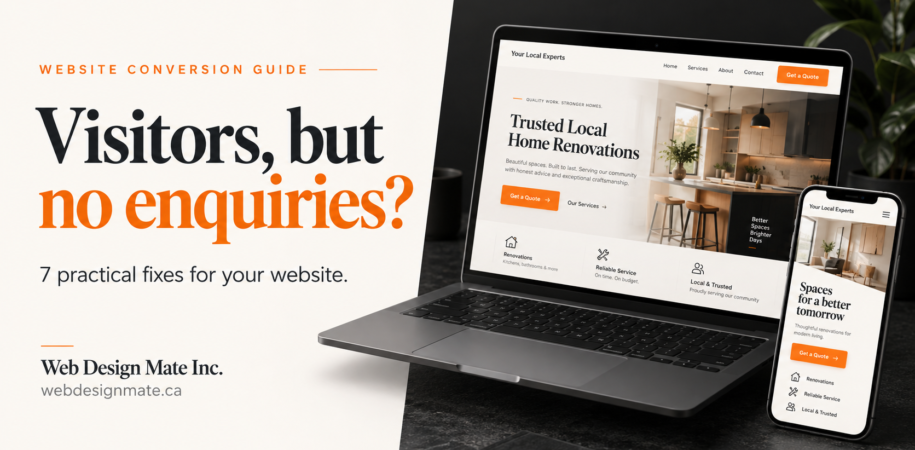

Your website is getting visitors, but your inbox is quiet. The phone barely rings, and the contact form brings more spam than genuine business opportunities. Before you spend more on advertising, look closely at what happens after someone lands on your website.
For a local business in Mississauga, Barrie or elsewhere in Ontario, a useful website should help potential customers answer three questions: Can you solve my problem? Can I trust you? What should I do next?
If those answers are difficult to find, even interested visitors may leave. Here are seven areas to investigate when your small business website is not generating leads, along with practical improvements you can make.
1. Your opening message leaves people guessing
“Welcome to our website” uses valuable space without explaining your business. A slogan such as “Excellence through innovation” can sound professional while telling a customer very little.
The first section of your homepage should explain what you offer, who you help and where you work. Follow that with a clear next step.
For example, a fictional renovation company could say: “Kitchen renovations for Barrie homeowners,” followed by a short explanation of its planning and installation services. A button labelled “Discuss Your Kitchen Project” gives the visitor a relevant action.
Try this quick check: show your homepage to someone unfamiliar with your company. Ask what you sell and who should contact you. If their answer is vague, simplify your headline before adding another animation or decorative section.
2. Your traffic does not match your ideal customer
More visits do not automatically mean more qualified enquiries. Someone reading a general tutorial may want to complete a task themselves. A visitor outside your service area may like your work but be unable to hire you.
Review which pages attract visitors and what those visitors appear to need. Separate useful educational traffic from searches that suggest someone is comparing providers or requesting a service.
Then make the connection between information and your offer clearer. A guide to planning a renovation should lead naturally to the relevant renovation service. A website planning article should help readers find your design services.
Avoid sending every campaign to the homepage. Match the landing page to the promise in the advertisement, including the service and location where relevant. A customer who clicked on a specific offer should not have to search for it again.
3. Your pages describe services but leave buying questions unanswered
A list of services is a useful starting point, but a potential customer needs enough detail to decide whether contacting you is worthwhile.
Explain what the service includes, who it suits, how the process works and what information is needed to prepare a quote. If pricing varies, explain the main factors instead of publishing an unreliable estimate.
For a website project, those factors might include the number of pages, content preparation, online payments, booking features and integrations. For a cleaning service, they could include property size, frequency and the work required.
Keep each service page focused. Use short sections and descriptive headings so visitors can find answers without reading every paragraph. Relevant detail helps customers assess fit before they contact you and gives your team a better starting point for the conversation.
4. Visitors cannot find enough evidence to trust you
A polished design creates an impression, but customers also want evidence that a real business stands behind it.
Use genuine project photos, accurate business details and testimonials you have permission to display. Explain your process and introduce the people customers will work with. Only include qualifications, memberships or guarantees that you can substantiate.
Place relevant proof near the decision it supports. A project example beside a service description is often more helpful than an isolated gallery with no explanation. Describe what the customer needed and what work was completed; avoid claiming results you did not measure.
For local businesses, make the service area clear. A visitor should not need to phone just to discover whether you work in their city. At the same time, avoid suggesting you have a physical office in a location where you only provide services.
5. Contacting you takes too much effort
A visitor may be interested but unwilling to complete a long questionnaire before having a basic conversation.
Ask for the information needed to respond usefully. A name, preferred contact method, service selection and short project description may be enough for an initial enquiry. Request additional details later when necessary.
Use specific button labels such as “Request a Website Quote” or “Ask About Availability.” Put a contact option near the top of important service pages and again after the information that helps someone decide.
Set honest expectations. Explain what happens after submission, and mention a response timeframe only if your team can consistently meet it. Offer a clearly visible phone number for people who prefer to call.
Most importantly, submit a test enquiry yourself. Confirm that it reaches the correct inbox and that the customer sees a useful confirmation. A form can look successful on screen while its notification never reaches your team.
6. The mobile experience gets in the way
A layout that looks good on your desktop may be awkward on a phone. Overlapping text, oversized banners, hidden menus and intrusive popups can make a simple enquiry frustrating.
Open your main service pages on a real phone. Read the headline, open the menu, tap the phone link and complete the contact form. Check whether the keyboard covers instructions or whether required fields are difficult to use.
Also check the page on a mobile connection. If important content appears slowly, investigate image sizes, embedded media and unnecessary scripts with your website provider. Fix the specific cause instead of installing additional performance plugins without a diagnosis.
The goal is a straightforward journey from understanding the service to requesting help. Every layout decision should support that journey.
7. You measure visits but not the quality of enquiries
Page views alone cannot tell you whether your website supports your business. Keep track of genuine enquiries, the service requested and whether those enquiries become qualified opportunities.
Distinguish actual form submissions from button clicks. A click on a phone link indicates intent; it does not prove a completed conversation. Exclude obvious spam and internal tests when reviewing results.
Start with a simple monthly record: relevant traffic, genuine enquiries, qualified leads and booked work. Record major website changes alongside those figures. Allow for seasonality, advertising changes and small sample sizes before drawing conclusions.
Improve one important area at a time where practical. If you change your offer, advertising, layout and contact process simultaneously, it becomes harder to identify what helped.
Do you need a complete website redesign?
Not every lead-generation problem requires a new website. Clearer copy, a repaired form or a simpler mobile layout may address the immediate issue.
A broader redesign may be appropriate when the navigation, page structure and design consistently prevent customers from finding information. Start with an assessment of the existing site and retain the elements that already work.
If a redesign changes page URLs, plan the migration carefully. Google recommends mapping old URLs to their new equivalents, implementing appropriate permanent redirects and updating internal links. See Google’s guidance on website URL changes. A visual refresh should not casually discard useful existing pages.
Frequently asked questions
Why am I getting traffic but no leads?
Possible causes include visitors who are a poor fit, unclear service information, limited trust signals or a difficult contact process. Check that your forms work before assuming the problem is your design or SEO.
Should I invest in SEO or improve my website first?
Investigate both visibility and the visitor experience. If suitable customers already reach your website but struggle to enquire, address those problems before scaling traffic. If very few relevant visitors arrive, review how people discover your services as well.
Can a redesign guarantee more enquiries?
No. Results also depend on demand, traffic quality, your offer, competition and follow-up. A redesign should solve identified problems and be evaluated against meaningful business outcomes.
Make it easier for your next customer to contact you
Web Design Mate Inc. offers website design and redesign services with attention to responsive layouts, clear content and usability.
If your website gets visitors but few enquiries, tell us where customers seem to get stuck. We can discuss your goals and the improvements your website needs.
Contact Web Design Mate to discuss your project.
Call: 437-227-3938
Email: saqib@webdesignmate.ca
Website: https://webdesignmate.ca

